Every monsoon, the same questions return.
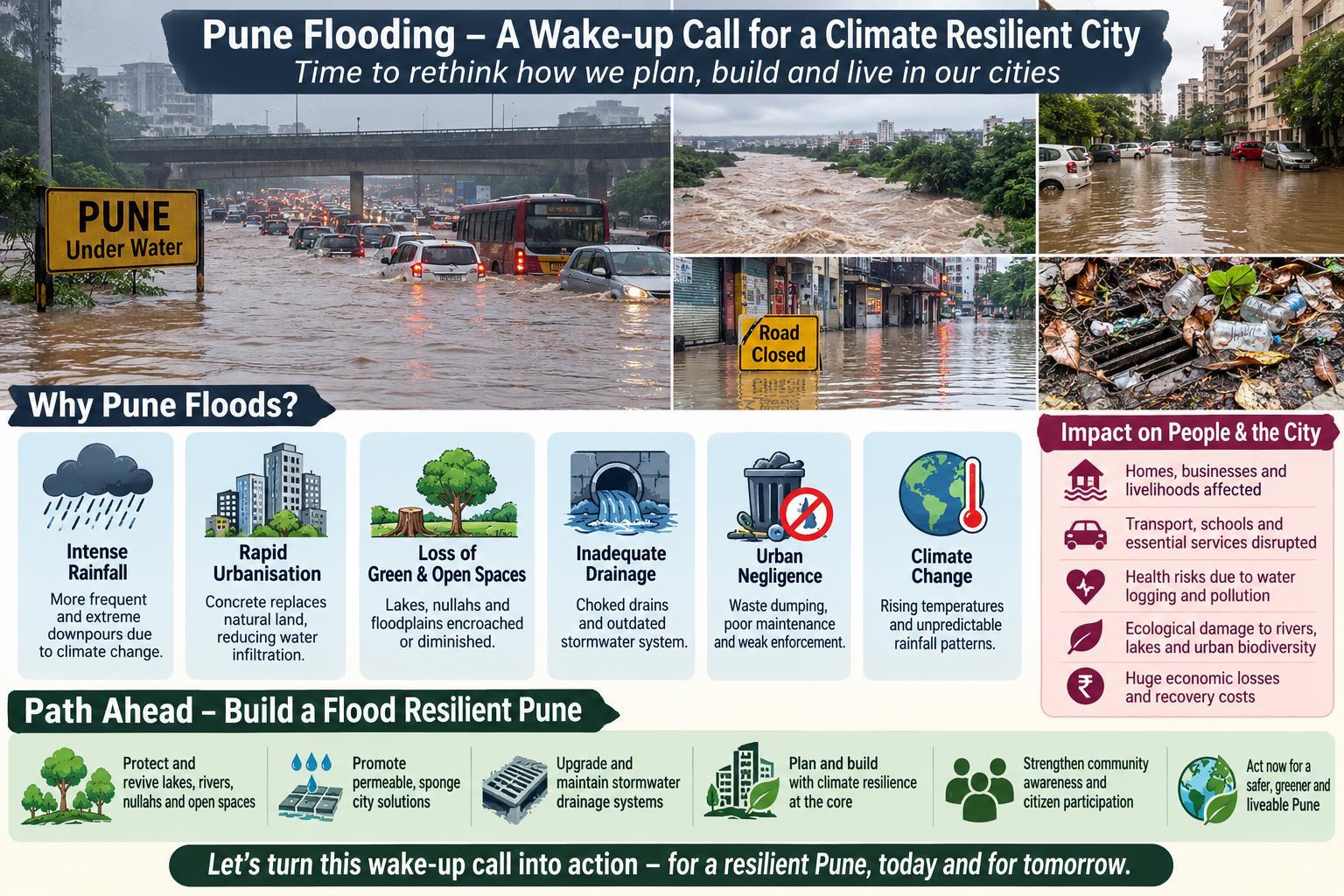
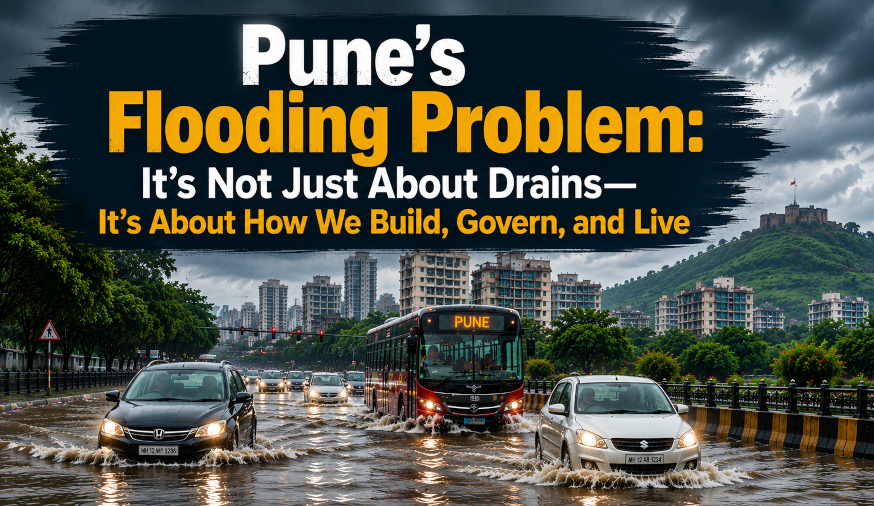
Why does Pune flood after just a few hours of intense rain? Why do roads resemble rivers? Why do traffic networks collapse? Why do newly developed areas remain waterlogged long after the rain has stopped?
The common answer is often, “The drainage system has failed.”
While drainage is certainly part of the problem, it is far from the whole story.
At Eco-Logic Foundation, our observations suggest that Pune’s flooding is the result of multiple interconnected factors—urban expansion without adequate planning, the loss of natural drainage channels, poor infrastructure maintenance, governance challenges, and everyday public behaviour. Solving the problem requires acknowledging that responsibility is shared.
A City That Outgrew Its Natural Systems
Pune has expanded at an extraordinary pace over the last two decades.
Residential townships, commercial developments, IT parks, educational institutions, and transportation infrastructure have transformed the city’s landscape. However, the pace of development has often exceeded the pace of infrastructure planning.
Land that once absorbed rainwater has increasingly been replaced by concrete, asphalt, and paved surfaces. As impermeable surfaces grow, less rainwater seeps into the ground and more runs rapidly across roads and into drainage systems that were never designed for such volumes.
The result is predictable: even moderate rainfall can overwhelm local infrastructure.
When Natural Drains Disappear
Historically, Pune’s topography included natural streams, seasonal channels, and low-lying drainage paths that safely carried storm water toward rivers.
Over time, many of these natural drainage corridors have been narrowed, encroached upon, diverted, or built over as the city expanded. In some locations, roads now occupy spaces that historically functioned as natural watercourses.
Water, however, follows gravity—not zoning plans.
When its original path is blocked, it simply finds the next available route.
Too often, that route is the city’s road network.
This explains why certain roads flood repeatedly despite repeated repairs—they are effectively acting as replacement drainage channels during heavy rainfall.
Drainage Networks Alone Cannot Solve the Problem
Storm water drains are designed based on assumptions about rainfall intensity, catchment characteristics, and runoff.
But when:
- urban density increases,
- open land disappears,
- natural channels are obstructed,
- construction alters land levels,
- and rainfall events become more intense,
even a well-designed drainage network can struggle.
Simply constructing larger drains without addressing these underlying issues treats the symptom rather than the cause.
Governance Matters
Municipal agencies, including the Pune Municipal Corporation (PMC), play a central role in urban resilience.
Storm water infrastructure requires regular maintenance, desilting before the monsoon, preservation of natural drainage corridors, enforcement against encroachments, coordinated road construction, and long-term infrastructure planning.
Equally important is ensuring that infrastructure projects are designed as connected systems rather than isolated works. Roads, drains, utilities, and new developments should complement one another instead of creating unintended consequences.
Where planning, maintenance, or coordination fall short, the city’s ability to manage heavy rainfall is inevitably reduced.
Citizens Also Shape the Outcome
Flooding is not solely an institutional problem.
Everyday actions by residents and businesses also affect how effectively the city manages rainwater.
Improper disposal of plastic waste and construction debris can block drains. Illegal connections to storm water systems reduce their efficiency. Paving every open surface eliminates opportunities for groundwater recharge. Encroachments into natural drainage paths, even on a small scale, collectively reduce the city’s capacity to convey storm water.
Urban resilience depends as much on civic responsibility as it does on engineering.
A city functions best when public infrastructure and public behaviour work together.
The Missing Piece: Integrated Urban Planning
Perhaps the most significant issue is the absence of truly integrated urban planning.
Roads are widened without fully considering drainage impacts. New developments are approved while surrounding infrastructure struggles to keep pace. Utilities are installed and later excavated repeatedly. Catchment-level planning often gives way to project-by-project implementation.
Effective urban planning considers an entire watershed—not just individual plots or road segments.
Every new building, parking area, flyover, or road changes how water moves through the city. Unless those changes are studied collectively, flooding will continue to shift from one neighbourhood to another.
Cities around the world increasingly use integrated storm water management, floodplain protection, green infrastructure, rainwater harvesting, retention ponds, permeable pavements, and watershed-based planning to reduce flood risk. Pune has an opportunity to adopt many of these proven approaches while adapting them to local conditions.
Flooding Is a Shared Responsibility
Reducing flooding cannot be achieved by one agency alone.
It requires coordinated action from municipal authorities, urban planners, engineers, developers, contractors, businesses, and citizens.
Municipal authorities must prioritise long-term planning, preserve natural drainage systems, maintain storm water infrastructure, enforce regulations consistently, and integrate drainage considerations into every infrastructure project.
Developers and consultants must design with the natural landscape rather than against it.
Citizens must protect public infrastructure by disposing of waste responsibly, avoiding encroachments, supporting rainwater harvesting, and recognising that individual actions collectively influence city-wide outcomes.
Building a More Resilient Pune
Flooding should not be viewed as an unavoidable consequence of urban growth.
It is a challenge that can be reduced through better planning, better governance, stronger engineering, and greater civic responsibility.
As professionals involved in infrastructure and project execution, we believe resilience begins long before the first brick is laid. It starts with understanding how cities function as interconnected systems—where roads, drainage, land use, environment, and communities are inseparable.
Pune has the expertise, resources, and opportunity to become a model for resilient urban development. Achieving that vision will require moving beyond reactive solutions and embracing a collaborative approach that values planning as much as construction.
Because when cities respect nature’s pathways, they become safer, stronger, and more sustainable for everyone.